

Finding a guardianship attorney is not the same as finding any attorney. Guardianship proceedings involve probate courts, capacity evaluations, ongoing reporting requirements, and in many cases, the most vulnerable people in your family. Getting the wrong attorney, or one who simply dabbles in guardianship between other practice areas, can cost you time, money, and in serious cases, the protection of someone who cannot protect themselves.
This guide walks you through how to find a qualified guardianship attorney, what credentials and certifications to look for, which professional associations can help you locate the right person in your state, and how to verify that the attorney you are considering actually practices in this area.
Why Guardianship Requires a Specialist
Guardianship law sits at the intersection of probate, elder law, family law, and disability rights. It is procedurally intensive. Courts require specific filings, notice to interested parties, capacity evaluations, and in most states, ongoing annual accountings and reports after the guardian is appointed.
A general practice attorney may technically be able to file a guardianship petition, but an attorney who handles these cases regularly will know the local court's preferences, the common pitfalls in contested matters, and how to move a case efficiently without triggering unnecessary delays or objections.
The difference matters most when:
- The case is contested by a family member
- The proposed ward has significant assets
- The ward is a minor with a complex custody or abuse history
- You are seeking emergency or temporary guardianship
- The case involves both guardianship of the person and conservatorship of the estate
Start With a Dedicated Guardianship Attorney Directory
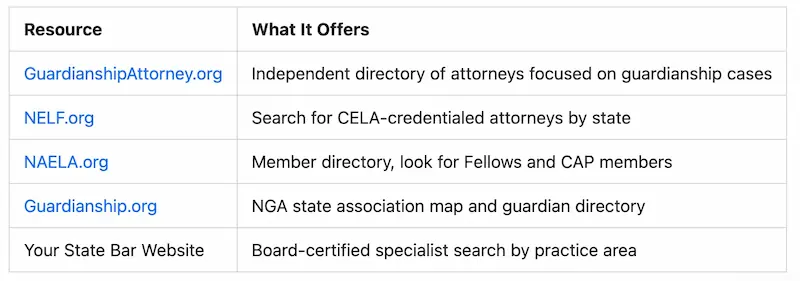
One of the most practical starting points is GuardianshipAttorney.org, an independent attorney directory built specifically to help families locate guardianship lawyers across the United States. The directory is not a law firm and does not provide legal advice, but it is designed to connect people with attorneys who actually handle guardianship cases, not general practitioners who list it as one of thirty practice areas.
The directory allows you to search by location and review attorney profiles that include contact information, practice focus, and service details. Attorneys listed have agreed to service standards including timely client response, which is a meaningful filter when you are dealing with a time-sensitive court matter.
This kind of focused directory is useful precisely because it pre-filters for practice relevance. That said, it should be one tool among several, not your only step.
Look for Attorneys With Recognized Credentials and Certifications
Not all attorneys who say they handle guardianship have formal credentials in the area. Here is what to look for:
CELA: Certified Elder Law Attorney
The most recognized national credential in this space is the Certified Elder Law Attorney (CELA)designation, issued by the National Elder Law Foundation (NELF). NELF is the only organization accredited by the American Bar Association to certify attorneys in elder and special needs law.
To earn the CELA designation, an attorney must:
- Pass a written examination
- Demonstrate substantial involvement in elder law practice
- Submit references from judges and fellow attorneys
- Complete ongoing continuing legal education requirements (at least 45 hours in elder law every three years)
Guardianship is a core component of elder law, so a CELA-credentialed attorney has been formally tested on it. You can search for CELA attorneys through NELF at nelf.org.
NAELA Membership and the Council of Advanced Practitioners
The National Academy of Elder Law Attorneys (NAELA), founded in 1987, is the leading professional association for attorneys in elder and special needs law. NAELA membership alone does not indicate certification, but NAELA Fellows and members of the Council of Advanced Practitioners (CAP) have demonstrated substantial contributions to the field through lecturing, writing, and practice.
NAELA maintains a searchable member directory at naela.org. When searching, look for attorneys who list guardianship or conservatorship as a primary focus, not just elder law generally.
State Bar Board Certification
Several state bars offer board certification in elder law or estate planning that covers guardianship. Examples include:
- California State Bar Board of Legal Specialization, which certifies attorneys in estate planning, trust, and probate law
- Florida Bar board certification in elder law
- Texas Board of Legal Specialization certification in estate planning and probate
If your state bar offers a relevant specialty certification, an attorney who holds it has passed a peer-reviewed process specific to that jurisdiction. Check your state bar's website directly, or use their attorney search tool and filter for certified specialists.
Use State and National Guardianship Associations
Beyond attorney-specific directories, guardianship associations can be a strong referral source because their members are practitioners embedded in the guardianship system, not just adjacent to it.
National Guardianship Association (NGA)
The National Guardianship Association at guardianship.org maintains a map of state guardianship associations and a searchable guardian directory. While NGA primarily represents professional guardians rather than attorneys, many attorney-guardians and guardianship-focused lawyers are active in NGA and its state affiliates. Their state-by-state map at guardianship.org/advocacy/guardianship-in-the-states is a useful starting point for finding your state's active guardianship community.
State-Level Associations
Most states have a guardianship or elder law association that holds regular CLE events and maintains referral networks. Examples include:
- Florida Guardianship Association
- California Advocates for Nursing Home Reform (CANHR), which maintains a lawyer referral service focused on elder law issues in California
- Texas Association of Professional Guardians
A quick search for "[your state] guardianship association" or "[your state] elder law bar section" will typically surface the relevant organization. These groups often maintain informal referral lists or can point you toward attorneys who are active in guardianship practice locally.
How to Verify an Attorney Actually Does Guardianship Work
Credentials and directory listings are a starting point. Here is how to go further before you hire:
1. Ask directly about volume. How many guardianship petitions have they filed in the past 12 months? How many are currently active? An attorney who handles these regularly will answer without hesitation.
2. Ask about the local court. Do they know the presiding probate judge in your county? Are they familiar with local filing requirements and preferences? Guardianship is intensely local.
3. Check their state bar profile. Confirm they are in good standing, check for any disciplinary history, and see how their profile describes their practice areas. Most state bars have free public lookup tools.
4. Look for published content or speaking history. Attorneys who genuinely specialize in guardianship often write articles, present at NAELA or NGA events, or contribute to bar association publications on the topic. A quick search of their name alongside "guardianship" or "elder law" can be revealing.
5. Ask about the bond requirement. Courts in most states require a guardian to obtain a surety bond before they can act. An attorney who handles guardianship regularly will know this immediately and be able to explain it. If they seem unfamiliar with the bond requirement, that is a red flag about their actual experience level.
A Note on Conservatorship vs. Guardianship
These terms are often used interchangeably in casual conversation but mean different things legally. In most states:
- Guardianship covers decisions about a person's physical care, medical treatment, and living arrangements
- Conservatorship covers financial decisions and management of assets
Some cases require both. Some states use different terminology entirely (California, for example, uses "conservatorship" for what other states call "guardianship of the estate"). Make sure the attorney you consult is clear on which proceeding applies to your situation and has experience with both if needed.
Quick Reference: Where to Search
Bottom Line
Finding the right guardianship attorney means going beyond a general Google search. Look for attorneys with CELA credentials, NAELA membership with a genuine guardianship focus, or state bar board certification in elder law or probate. Use dedicated resources like GuardianshipAttorney.org to find attorneys who have self-identified as guardianship practitioners, and cross-reference with your state's guardianship or elder law association. Then verify with direct questions before you hire.
Guardianship proceedings affect real people in real time. The attorney you choose should be someone who lives in this area of law, not just visits it occasionally.
This article is for informational purposes only and does not constitute legal advice. Guardianship laws vary by state. Consult a licensed attorney in your jurisdiction for guidance specific to your situation.